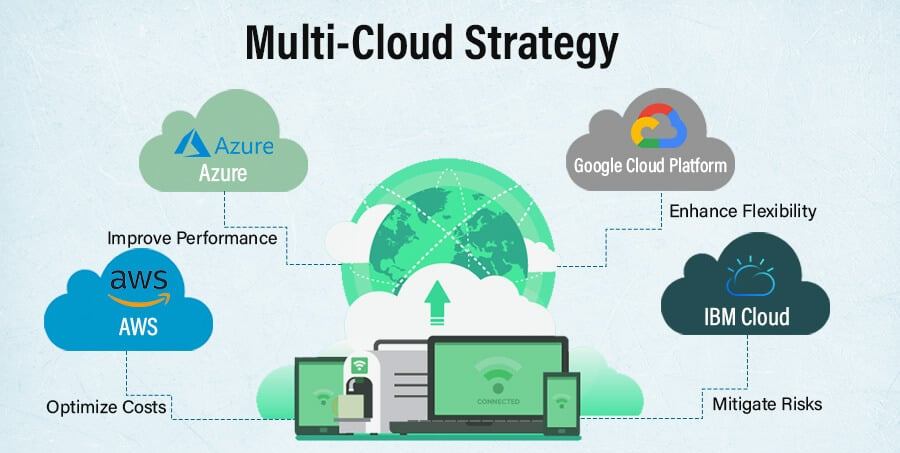
A multi-cloud strategy—using services from multiple cloud providers—has rapidly become a key trend in cloud adoption. Organizations no longer rely on a single provider like AWS, Azure, or Google Cloud. Instead, they take advantage of each platform’s strengths to build resilient, cost-effective, and high-performing systems. As digital infrastructure grows more complex, multi-cloud strategies offer flexibility and freedom that single-cloud environments cannot.
Traditionally, businesses migrated to one major cloud platform to reduce reliance on physical infrastructure. This approach simplified management but introduced a new issue: vendor lock-in. Companies relying heavily on one provider’s services found it difficult and expensive to switch platforms. Multi-cloud strategies emerged as a solution, offering independence and negotiating leverage.
One major advantage of multi-cloud adoption is resilience. If one provider experiences an outage—a rare but possible event—critical services can fail over to another cloud. This ensures uptime and reliability, especially for industries like finance, healthcare, and e-commerce. By distributing workloads across providers, organizations can maintain business continuity even during outages or disruptions.
Cost optimization is another key benefit. Each cloud provider offers different pricing models, discounts, and performance options. With a multi-cloud approach, companies can choose the most cost-effective platform for compute, storage, analytics, or databases. For example, a business might run AI workloads on Google Cloud’s TPU infrastructure while using AWS for storage and Azure for identity services.
Multi-cloud also enhances performance by reducing latency. Global companies can select data centers closest to their users regardless of which provider owns them. This improves speed, user experience, and responsiveness—critical for real-time applications.
Innovation is a major reason for multi-cloud adoption. Each cloud provider excels in different areas:
-
AWS: scalability, serverless, and enterprise integration
-
Azure: identity services, hybrid cloud, enterprise solutions
-
Google Cloud: AI, machine learning, and Kubernetes leadership
By mixing and matching services, companies build superior solutions that leverage the strengths of each cloud ecosystem.
However, multi-cloud strategies come with challenges. The biggest is complexity. Managing multiple providers means more tools, dashboards, APIs, and billing systems. Without proper visibility, teams risk security gaps, misconfigurations, and resource sprawl. Additionally, networking becomes complicated when connecting systems across clouds.
Security is another concern. Each provider has its own security tools, policies, and compliance requirements. Ensuring consistent identity management and encryption across platforms requires careful planning. Zero-trust architecture and centralized IAM solutions are essential for reducing risks.
To ensure successful multi-cloud adoption, organizations should follow best practices:
-
Standardize deployment workflows using tools like Terraform, Kubernetes, or CI/CD pipelines.
-
Use centralized monitoring to maintain visibility across clouds.
-
Adopt cloud-agnostic design, avoiding dependencies on a single provider’s proprietary services.
-
Implement strong governance for billing, security, and resource management.
-
Choose the right workloads for each cloud based on performance and cost.
Multi-cloud strategies offer freedom, scalability, and security—but only when properly implemented. As organizations continue embracing digital transformation, multi-cloud adoption will remain a cornerstone of modern cloud architecture.