A decade ago, businesses rushed to move everything into a single cloud ecosystem.
Today, many are reversing that approach.
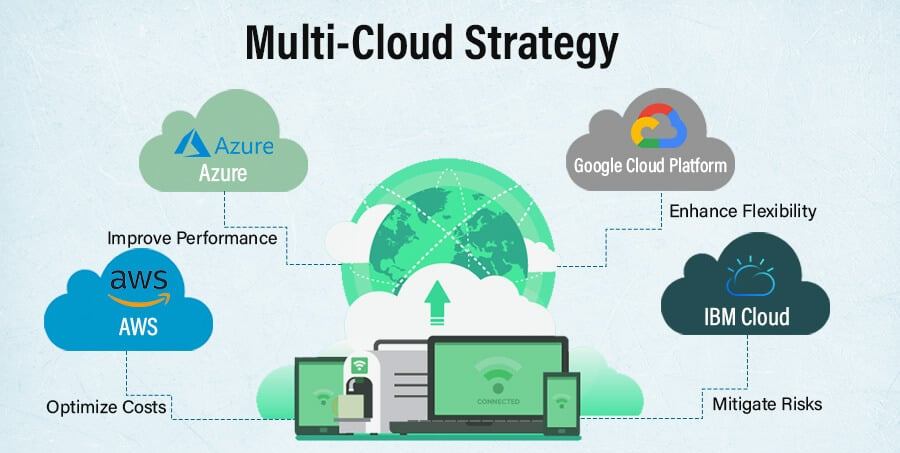
In 2026, enterprises increasingly operate across multiple cloud platforms including AWS, Microsoft Azure, Google Cloud, Oracle Cloud, and private infrastructure environments.
The reason is simple.
Relying on one provider creates risk.
Downtime, pricing changes, compliance challenges, and vendor dependency pushed organizations toward flexible cloud strategies that distribute workloads across several platforms.
This is why multi-cloud adoption continues rising across finance, healthcare, SaaS, e-commerce, and manufacturing sectors worldwide.
What Is a Multi-Cloud Strategy?
A multi-cloud strategy means using services from multiple cloud providers instead of depending on a single platform.
For example:
- AWS for infrastructure
- Google Cloud for AI workloads
- Azure for enterprise integrations
- Private cloud for sensitive data
Businesses choose different providers based on pricing, performance, regional availability, and specialized capabilities.
Why Companies Are Leaving Single-Cloud Dependency
Vendor Lock-In Concerns
Many organizations discovered how difficult it becomes to migrate once applications deeply depend on one ecosystem.
Switching providers later can be expensive and technically painful.
Multi-cloud reduces that dependency.
Better Disaster Recovery
Outages happen.
Even the biggest providers experience service disruptions.
Multi-cloud architecture allows businesses to maintain operations if one platform fails.
For industries like banking and healthcare, uptime is critical.
Regulatory Compliance
Global regulations differ by country.
Companies operating in the United States, India, Europe, and the Middle East often need localized storage and region-specific compliance controls.
Multi-cloud infrastructure helps meet those requirements.
Cost Optimization
Cloud costs can spiral quickly.
Enterprises now compare providers aggressively to optimize workloads based on pricing.
Some platforms offer cheaper storage. Others provide better GPU pricing for AI training.
Businesses increasingly mix services to control spending.
Hybrid Cloud vs Multi-Cloud
These terms are often confused.
They are not the same.
| Feature | Hybrid Cloud | Multi-Cloud |
| Uses Public and Private Cloud | Yes | Sometimes |
| Uses Multiple Providers | Not Always | Yes |
| Main Goal | Infrastructure Flexibility | Provider Diversification |
| Common Enterprise Use | Legacy Integration | Cost and Resilience |
Hybrid cloud combines private and public infrastructure.
Multi-cloud focuses on using multiple vendors.
Many enterprises now combine both models.
Cloud Providers Leading the Market
Amazon Web Services (AWS)
AWS remains dominant in infrastructure services and enterprise scalability.
Microsoft Azure
Azure continues growing rapidly due to deep enterprise software integrations.
Google Cloud Platform (GCP)
Google Cloud is gaining traction for AI, machine learning, and analytics workloads.
Oracle Cloud Infrastructure
Oracle attracts enterprises with database-heavy environments and financial systems.
Security Challenges in Multi-Cloud Environments
Managing multiple platforms increases complexity.
That complexity introduces new security concerns.
Identity Management
Organizations need centralized authentication systems across providers.
Misconfiguration Risks
One poorly configured storage bucket can expose sensitive information.
Compliance Monitoring
Security teams must maintain visibility across multiple ecosystems.
This is why cloud security platforms are becoming essential for enterprise governance.
How AI Is Changing Cloud Computing
AI demand is reshaping cloud infrastructure faster than expected.
Businesses now prioritize:
- GPU availability
- AI model deployment
- Data processing speed
- Edge computing integration
- Real-time analytics
Cloud providers are competing aggressively in the AI infrastructure race.
That competition benefits enterprise customers.
The Rise of Sovereign Cloud Infrastructure
Governments increasingly want greater control over national data.
This trend accelerated in Europe, India, and parts of Asia.
Sovereign cloud solutions allow countries and enterprises to keep sensitive data within regional boundaries while still accessing modern cloud services.
Expect this trend to grow significantly over the next few years.
What Businesses Should Prioritize
Companies planning cloud expansion should focus on:
Clear Workload Distribution
Not every workload belongs on the same provider.
Cloud Cost Visibility
FinOps practices are becoming essential.
Security Automation
Manual cloud monitoring is no longer enough.
Scalability Planning
AI workloads require flexible infrastructure planning.
Final Thoughts
Multi-cloud is no longer a niche enterprise strategy.
It is becoming the standard architecture for global businesses that want flexibility, resilience, and long-term control.
Organizations adopting smarter cloud governance today will be better prepared for rising AI demands, stricter compliance requirements, and increasingly competitive digital markets.
The future of cloud computing will not belong to one provider.
It will belong to companies that know how to use several effectively.